Anatomical Position
Lets examine the anatomical position. This is a frame of reference you will be using for the rest of your clinical lives. From this frame of reference, precise positional information about a clinical condition can be described to a colleague.
In the anatomical position the individual is standing, feet together, arms to the sides, head pointing forwards, and the palms of the hands oriented to face forwards.
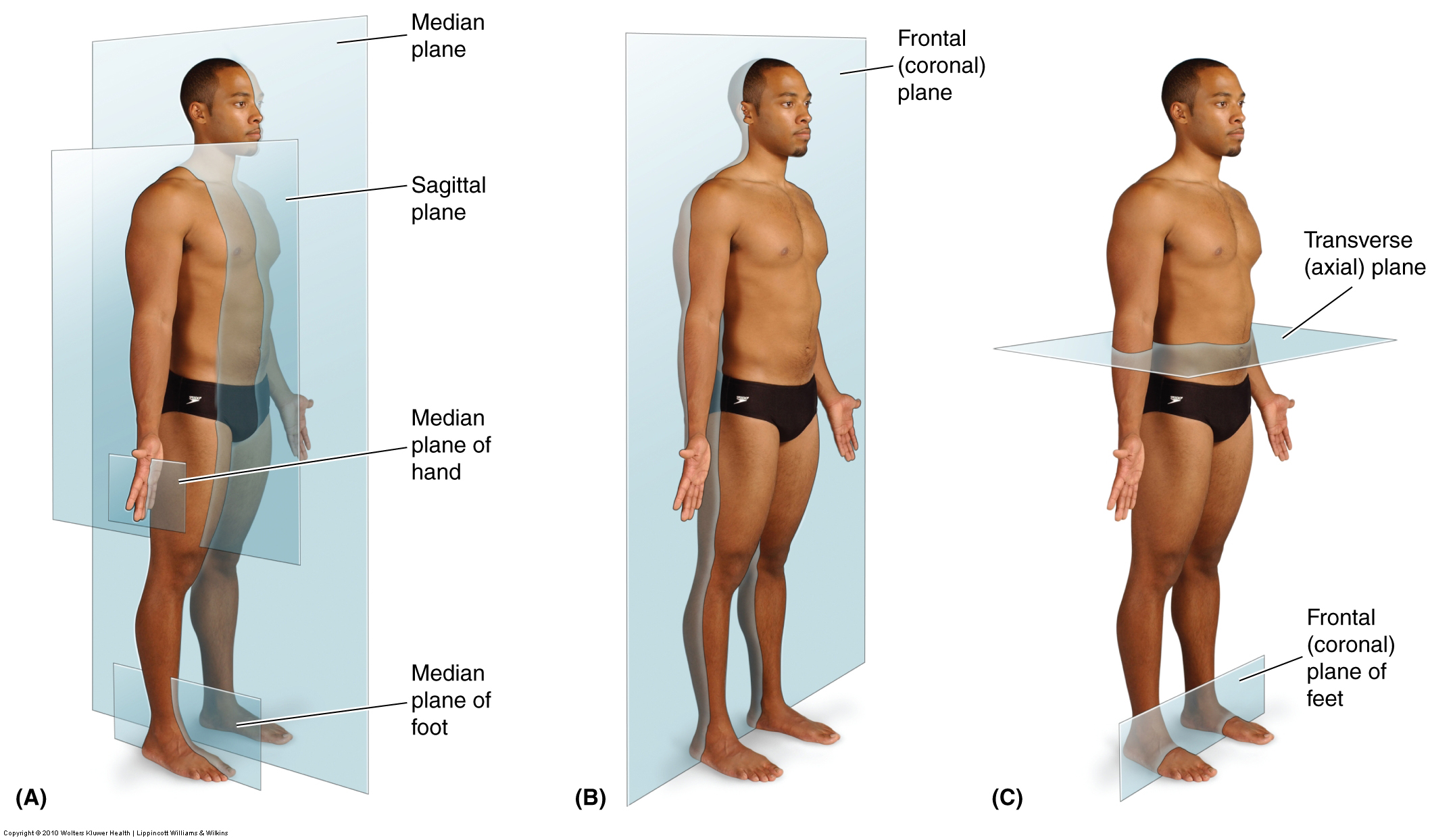
From the anatomical position a number of planes that pass through the body are defined
| MEDIAN - a plane
exactly along the midline separating the body into a left and right. SAGITTAL - any plane parallel to the median plane |
FRONTAL (or coronal) - any plane separating the anterior (front) and posterior (back) sides of the body. | HORIZONTAL (or transverse) - any plane that separates the superior and inferior sides of the body. This is the most common plane to see in CT or MRI radiology imaging. |
From the anatomical position a number of directions are also defined.
As you move towards the center of the body (the skull & vertebral column), you are moving medially. If you move from the midline toward the side, you then move laterally. Note in the figure below the various arrows depicting anterior, posterior, medial, lateral, proximal, distal, superior, inferior, etc. These are all critical to become familiar with as dissection and anatomical instructions are all presented using these terms. Combinations are also commonly used to indicate position, for example anteromedial (in an anterior direction towards the midline), superolateral (in a superior direction towards the lateral side), etc. It is also important to note all directions are given from the patients perspective, when you say 'on the left' it is always the patients left.
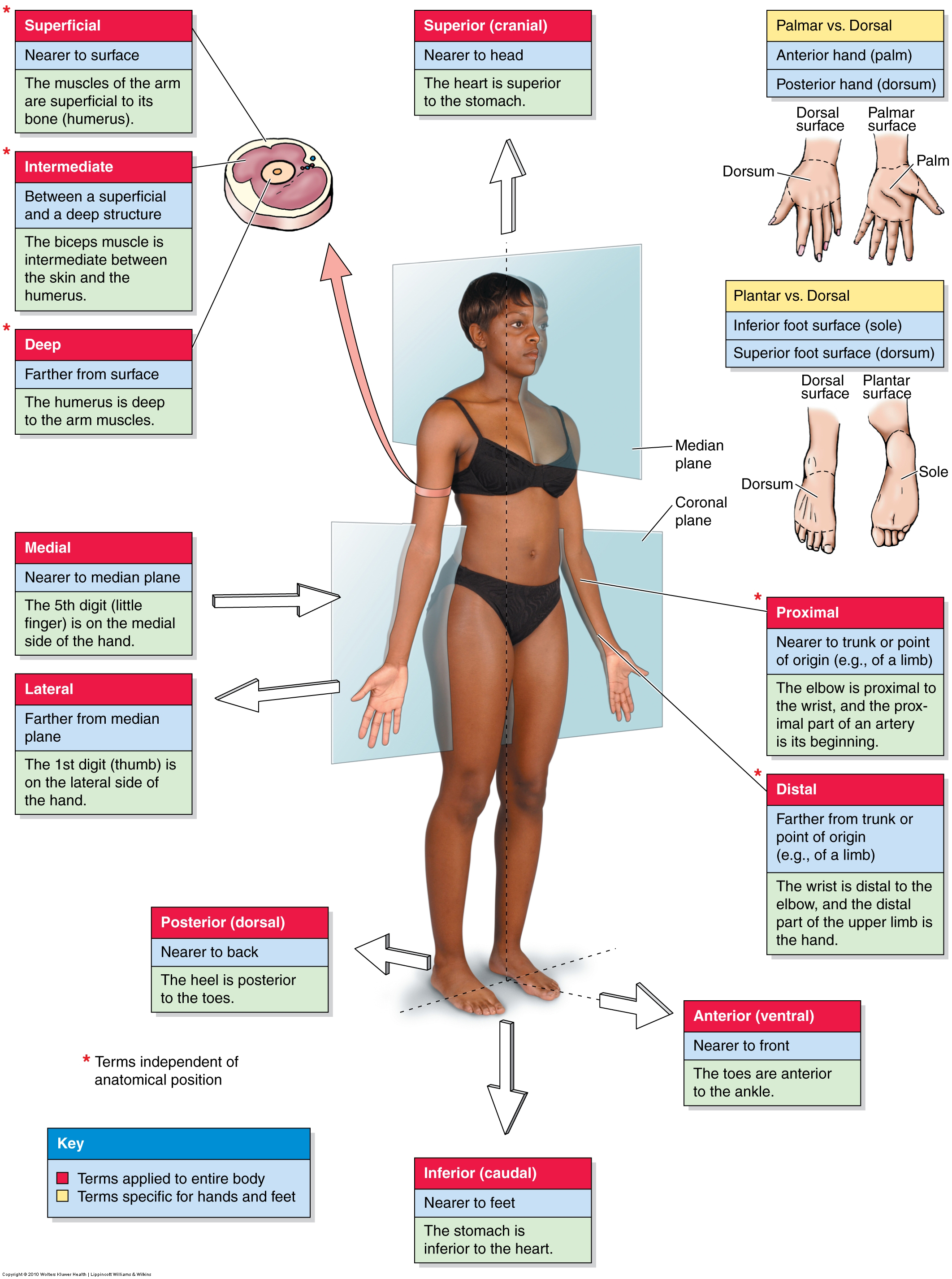
With regard to depth position, nerves, muscles or organs closer to the surface are superficial to structures deeper. So, the skin is the most superficial feature of our body. Thus, one would describe a muscle as being “deep” to the skin. If a nerve lies deep to or below a muscle, it is below it as viewed from the skin surface.
Finally, if an individual lies on their back they are said to be in the supine position. If if an individual lies on their front they are said to be in the prone position.